Annual Reports
Weibo Corporation's annual reports contain management's most considered account of the business. These are the sections, passages and visual pages worth opening in the originals preserved in Sources.
Weibo Corporation — FY2025 Annual Report (Form 20-F) — FY2025
The latest full account of the platform, the VIE structure it is owned through, and a third straight year of ~$1.76bn revenue. · Open the full document →
Item 3. Key Information — Our Holding Company Structure and Contractual Arrangements with the VIEs and Their Respective Individual Shareholders — p. 7 · Read the full section →
States plainly what a shareholder owns: a Cayman shell whose consolidated revenue is 86% earned inside entities it does not own.
Holding-company framing and the share of revenue earned by the VIEs.
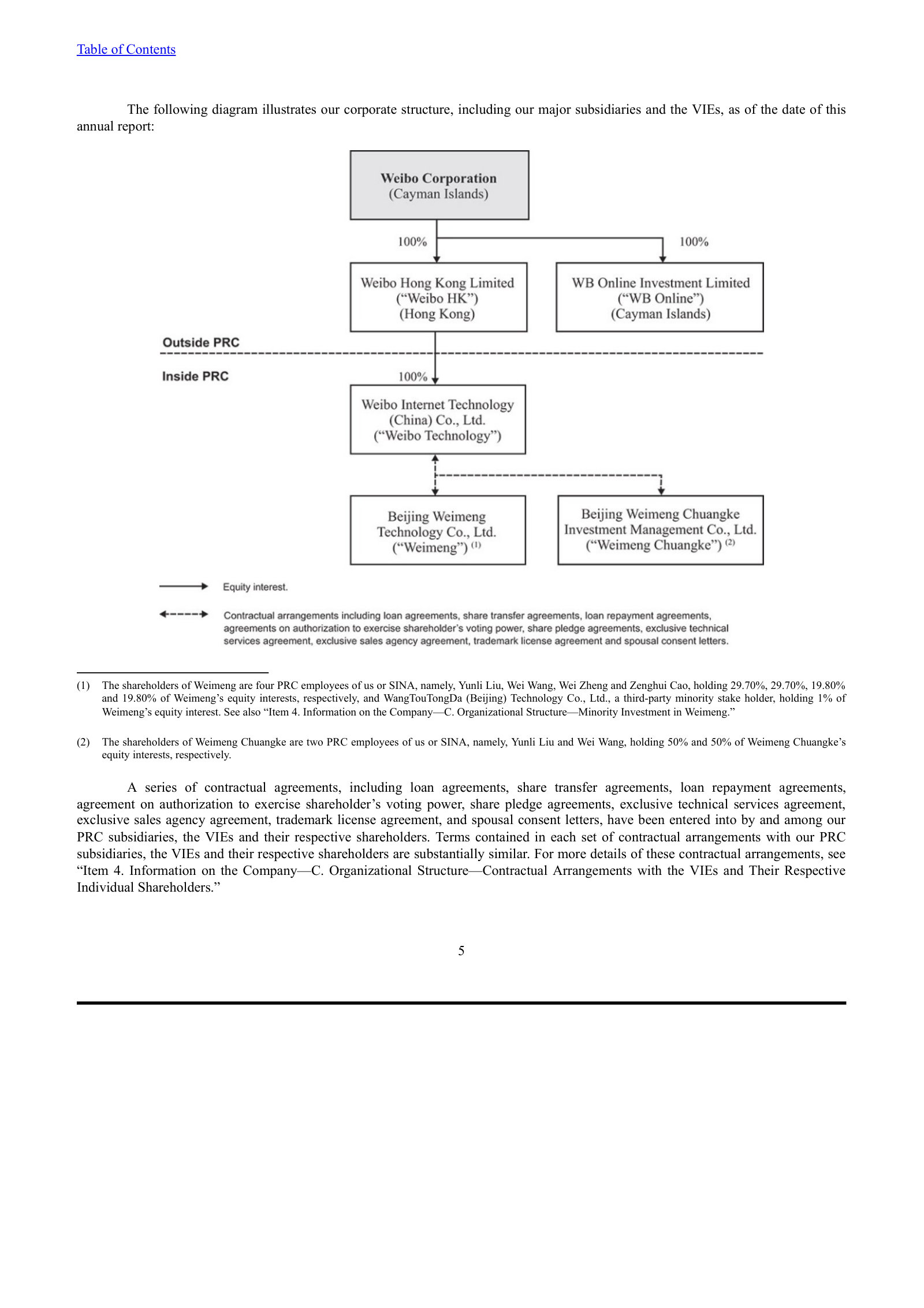
Weibo Corporation is not an operating company in China, but a Cayman Islands holding company with no equity ownership in the VIEs. […] Revenues contributed by the VIEs and their subsidiaries accounted for 87.0%, 86.2% and 85.9% of our total revenues for the years of 2023, 2024 and 2025, respectively.
p. 7 · Read in context →
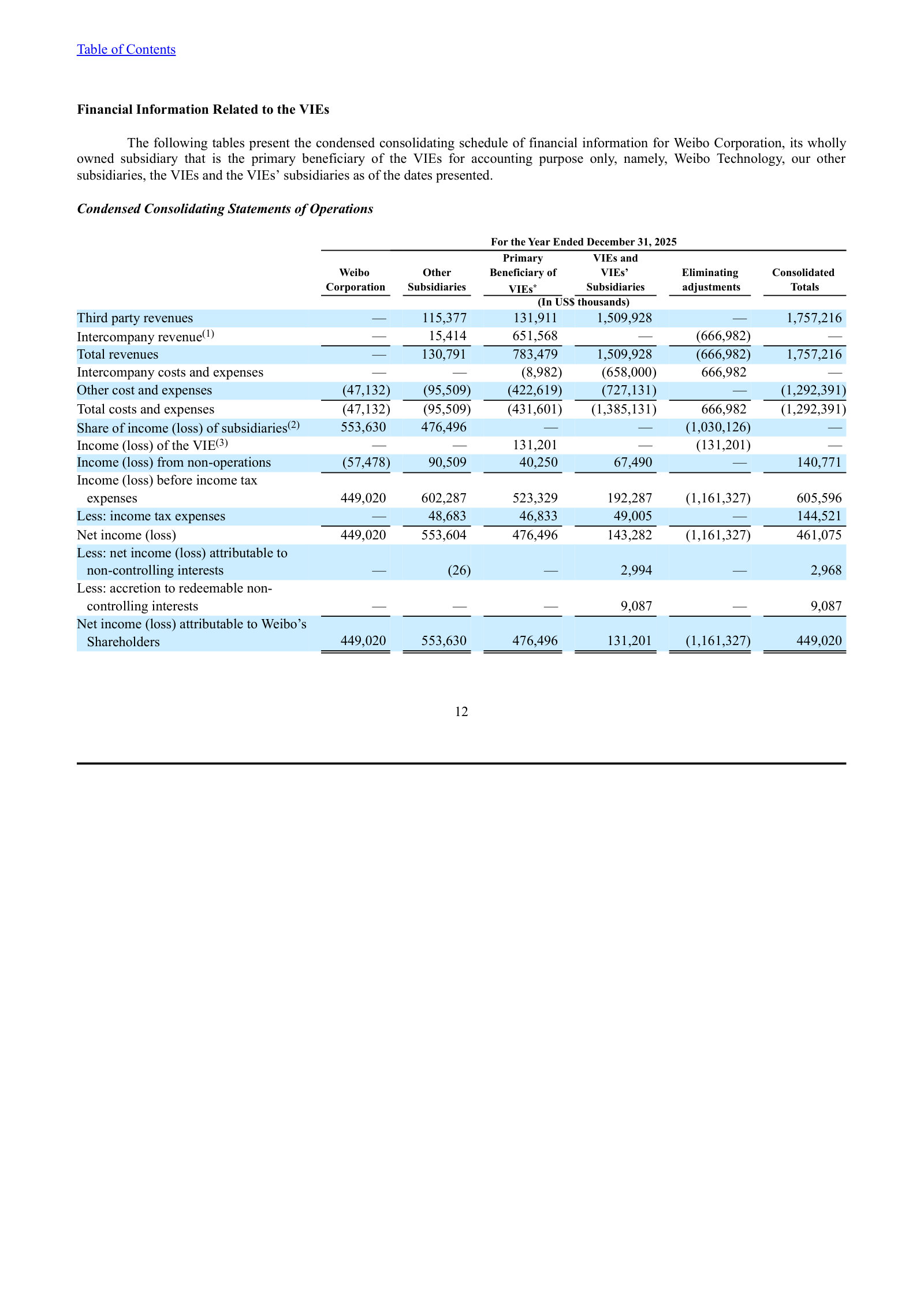
Financial Information Related to the VIEs — p. 15 · Read the full section →
The condensed consolidating schedule separates the holding company, the WFOE and the VIEs — where the revenue and the profit actually sit.
If we are unable to compete effectively for user traffic or user engagement, our business and operating results may be materially and adversely affected. — p. 26 · Read the full section →
Names the specific apps taking Chinese social time — the competitive set that explains four flat revenue years.
The named competitive set, from WeChat to Douyin and RedNote.
Competition for user traffic and user engagement is intense and we face strong competition in our business. It is possible that a new product could gain rapid scale through harnessing a new technology (such as generative AI), or a new or existing distribution channel, creating a new or different approach to connecting people or some other means. Major Chinese internet companies, such as Tencent and Bytedance, compete directly with us for user traffic and user engagement, content, talent and marketing resources. […] These services include (i) messengers and other social apps and sites, such a Weixin/WeChat; (ii) multimedia apps (such as photo, video and live streaming apps), such as Douyin/TikTok, Kuaishou, Bilibili Xiaohongshu (also known as RedNote), iQiyi, Tencent Video and Youku; and (iii) news apps and sites operated by other major internet companies, such as Tencent and Bytedance.
p. 26 · Read in context →
Alibaba is a significant customer and an important strategic partner of ours. If we fail to maintain our collaboration with Alibaba, our results of operations and growth prospect may be adversely and materially affected. — p. 30 · Read the full section →
Alibaba supplied $173.8m of FY2025 advertising revenue and all of the year's growth; here that dependence is disclosed.
Alibaba as shareholder, partner and customer at once.
Alibaba is an important strategic partner, a major shareholder and a significant customer of ours since our IPO in 2014. […] If we are unable to either maintain strong cooperation with Alibaba or find other customers that can bring in similar amount of revenues to offset the possible decline of revenue from Alibaba or the revenue associated with Alibaba’s ecosystem, our results of operations and growth prospects may be adversely and materially affected.
p. 30 · Read in context →
User misconduct and inappropriate content may adversely impact our brand image, business and results of operations, and we may be held liable for information or content displayed on, retrieved from or linked to our app or website or distributed to our users. — p. 36 · Read the full section →
For a Chinese public-conversation platform, content liability is the operating risk: fines and service suspensions, not lawsuits.
Content moderation as a regulatory exposure.
While we have developed technologies and a series of measures to detect inappropriate content and activities, we cannot guarantee that we will be able to fully prevent inappropriate content from being posted on our platform or inappropriate activities from being carried out on our platform. […] It is possible that our users may engage in conversations or activities on our platform that may be deemed illegal under applicable laws and regulations. We may be subject to fines or other disciplinary actions, including suspension of certain services, if we are deemed to not have taken actions to stop user misconduct […]
p. 36 · Read in context →
If the PRC government determines that the contractual arrangements constituting part of the VIE structure do not comply with PRC regulations on foreign investment in internet and other related businesses, or if these regulations or their interpretation change in the future, we could be subject to severe penalties or be forced to relinquish our interests in those operations — p. 50 · Read the full section →
The structural risk stated at its sharpest — control rests on contracts, and the shares carry no equity in the operating entities.
Contractual control, consolidation under U.S. GAAP, and what investors actually buy.
As a result of these contractual arrangements, we exert control over Weimeng and Weimeng Chuangke and treat them as consolidated VIEs. Consequently, we consolidate their operating results in our financial statements under U.S. GAAP. […] Investors of our Class A ordinary shares and/or the ADSs are not purchasing equity interest in the VIEs in China but instead are purchasing equity interest in a Cayman Islands holding company with no direct equity ownership of the VIEs.
p. 50 · Read in context →
Item 4. Information on the Company — B. Business Overview — p. 86 · Read the full section →
Management's own description of the platform and its scale, plus the definitions that govern how advertising revenue is booked.
Platform description and December 2025 user scale.
Weibo is a leading social media platform in China for people to create, discover and distribute content. […] We had 567 million MAU and 252 million average DAUs in December 2025.
p. 86 · Read in context →
Who the customer is: the agency, not always the advertiser.
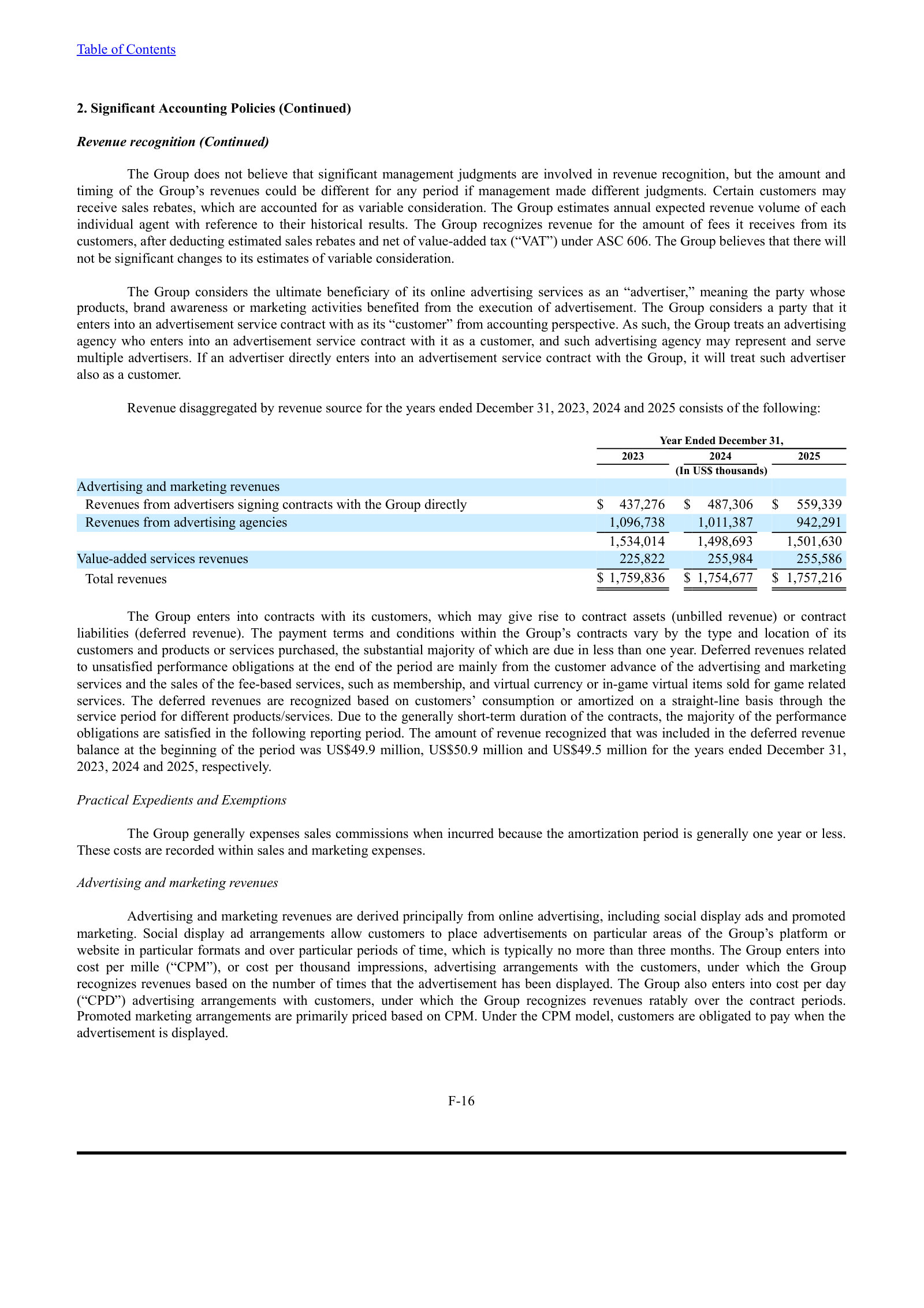
We consider the ultimate beneficiary of our online advertising services as an “advertiser,” meaning the party whose products, brand awareness or marketing activities benefited from the execution of advertisement. We consider a party that we enter into an advertisement service contract with as our “customer” from accounting perspective. As such, we treat an advertising agency who enter into an advertisement service contract with us as our customer, and such advertising agency may represent and serve multiple advertisers.
p. 89 · Read in context →
Item 5. Operating and Financial Review and Prospects — Results of Operations — p. 137 · Read the full section →
Three years side by side, then management's explanation of a flat top line: fewer advertisers spending more, and Alibaba filling the gap.
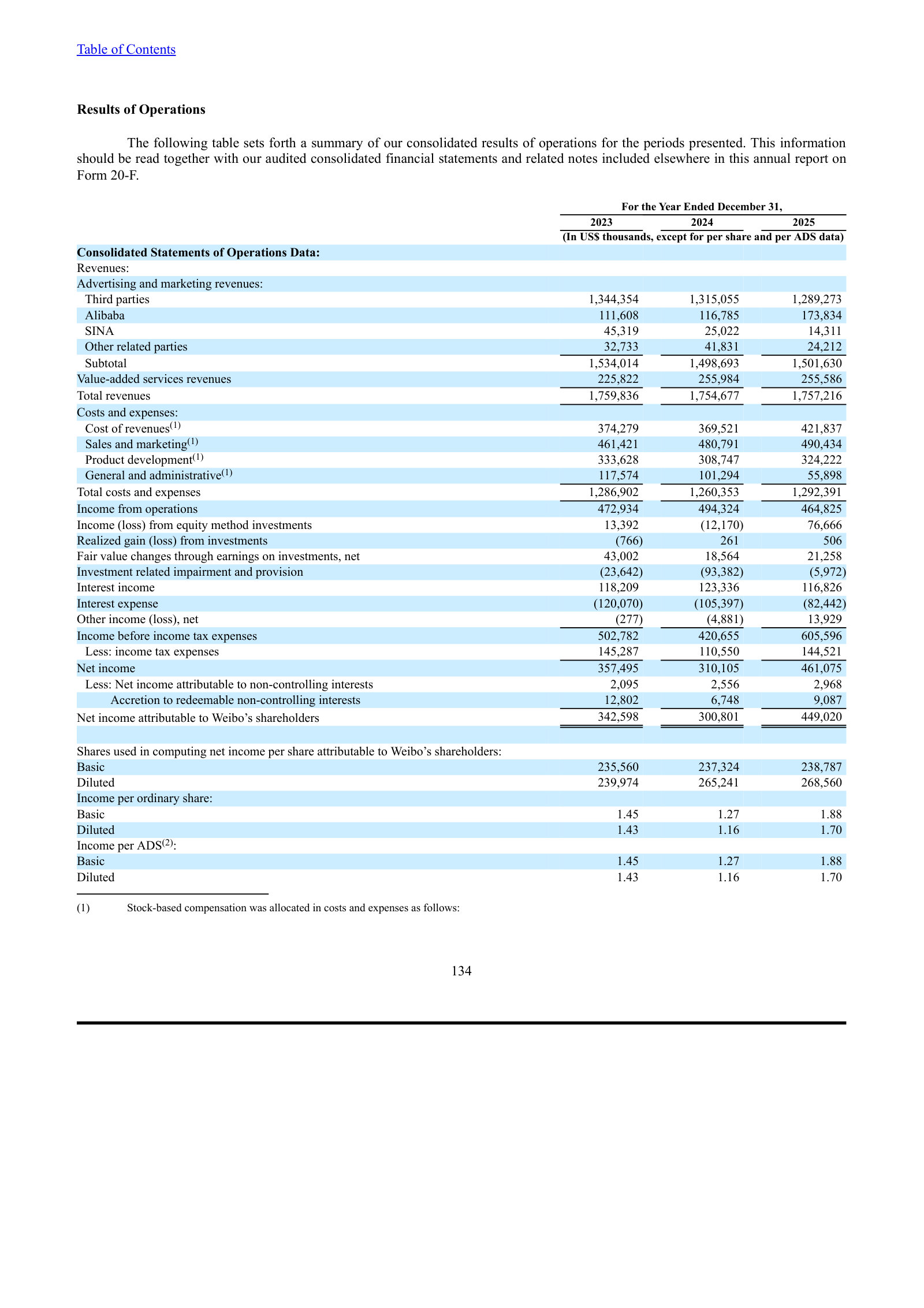
Advertiser count, spend per advertiser and the Alibaba contribution in 2025.
Advertising and Marketing Revenues. Advertising and marketing revenues were US$1,501.6 million in 2025, remaining relatively flat compared to US$1,498.7 million in 2024. The total number of advertisers was 0.4 million in 2025, compared to 0.6 million in 2024, while the average spending per advertiser (excluding Alibaba) increased by 39% from US$2,438 in 2024 to US$3,385 in 2025, both of which were primarily due to the churn of advertisers with relatively lower advertising budgets. […] Revenues from advertising customers (excluding Alibaba) decreased by 4% from US$1,381.9 million in 2024 to US$1,327.8 million in 2025, mainly attributable to fierce market competition. Revenues generated from Alibaba increased by 49% from US$116.8 million in 2024 to US$173.8 million in 2025, driven by deeper collaboration between Alibaba and us during key e-commerce marketing windows.
p. 138 · Read in context →
Note 2. Significant Accounting Policies — Revenue recognition — p. 209 · Read the full section →
Defines the revenue model: campaigns booked gross with creator payouts in cost of revenues, and direct versus agency customers.
Why creator payouts sit in cost of revenues rather than netting against revenue.
Contracts with customers of online advertising may require cooperation from third parties. The Group pays a predetermined portion of revenues earned from advertising contracts to the third parties such as key opinion leaders who participate in advertising and promotion activities by monetizing their social assets. The Group has determined that it is the principal in these transactions […] The Group records revenues derived from such contracts on a gross basis and the portion paid to the third parties is recognized as cost of revenues
p. 211 · Read in context →
Weibo Corporation — FY2021 Annual Report (Form 20-F) — FY2021
The peak-revenue edition, kept for one section: results reported on a customer taxonomy Weibo has since stopped disclosing. · Open the full document →
Item 5. Operating and Financial Review and Prospects — Results of Operations — p. 120 · Read the full section →
The peak year — $2,257.1m of revenue — and a customer disaggregation (key accounts versus SMEs) the company no longer publishes.
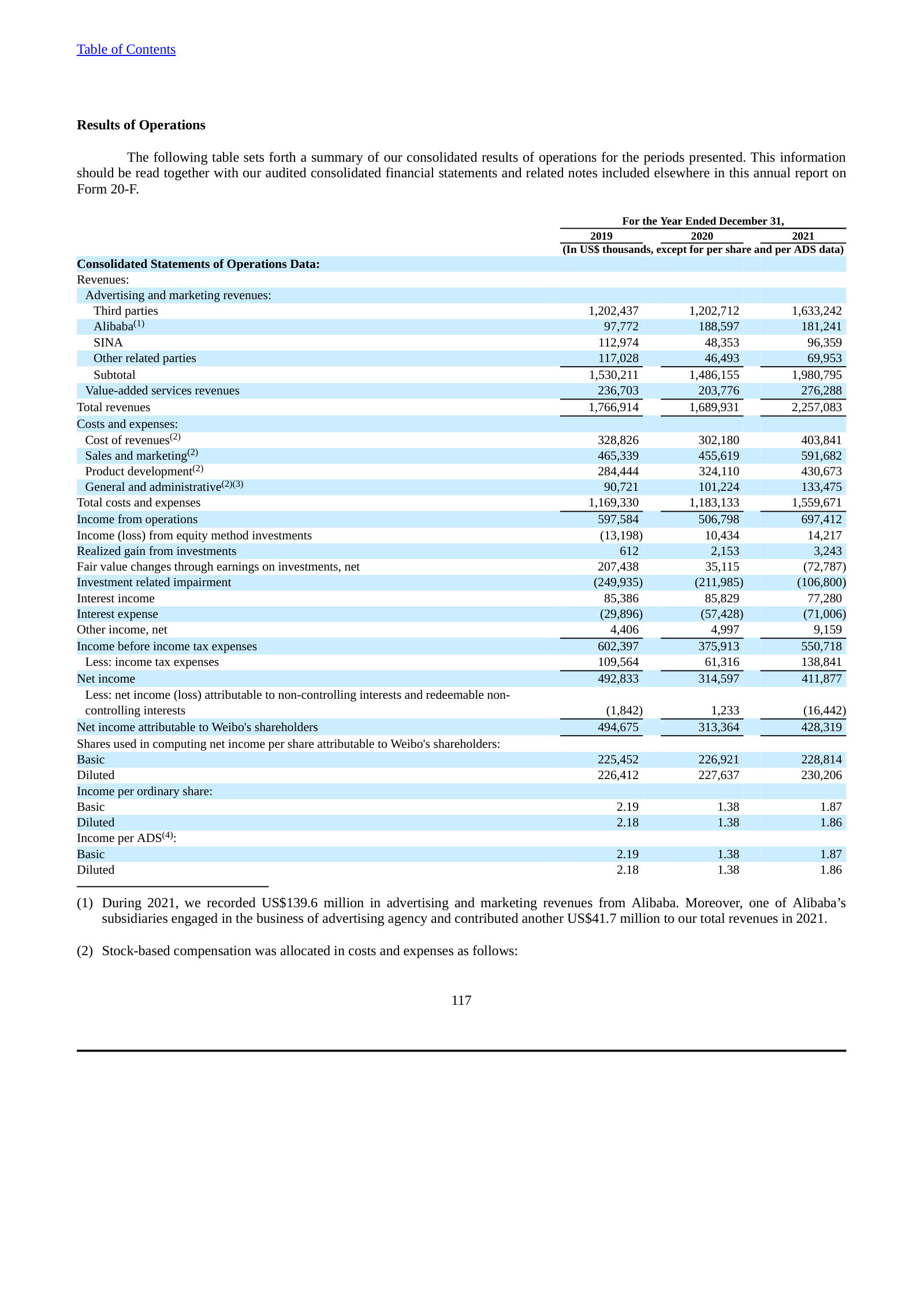
The key-accounts / SME split, discontinued in later filings.
Revenue from key accounts grew by 2% from US$729.3 million in 2019 to US$741.5 million in 2020, largely attributable to the strong relationship between Weibo and brand advertising customers […] Revenue from SMEs decreased by 16% from US$703.2 million in 2019 to US$592.7 million in 2020, mostly due to the relatively slower recovery pace of the SME sector during the COVID-19 pandemic and intense market competition.
p. 122 · Read in context →
More annual reports
Weibo Corporation — FY2024 Annual Report (Form 20-F) — FY2024 · 259 pages · Prior-year baseline for the FY2025 comparisons, including the $93.4m of investment impairments taken that year. · Open →
Weibo Corporation — FY2023 Annual Report (Form 20-F) — FY2023 · 522 pages · The year the first special dividend was declared, and the start of the three-year window shown in FY2025. · Open →
Weibo Corporation — FY2022 Annual Report (Form 20-F) — FY2022 · 487 pages · Filed while Weibo was a Commission-Identified Issuer under the HFCAA; documents the revenue decline from the 2021 peak. · Open →